Cutting the Supply Lines: A Metabolic Approach to Angiogenesis & Metastasis — and How Food Helps Tip the Balance Back
By Debbie Sweeney, BCHN, FDN-P, ONC
Two of the original hallmarks of cancer describe the moment a tumor stops being a local problem and becomes a systemic one: inducing angiogenesis (recruiting its own blood supply) and activating invasion and metastasis (spreading to distant tissue).12 Metastasis — not the primary tumor — is responsible for the large majority of cancer-related deaths.3 In the terrain model, neither of these is a random accident. Both are behaviors a tumor learns from the conditions around it. Change the conditions, and you change the incentives — that is the whole premise of terrain over tumor.
A cluster of cancer cells can only grow to roughly 1–2 mm before it outstrips the oxygen and nutrients that reach it by simple diffusion. To grow beyond that, it has to recruit new blood vessels — angiogenesis. Judah Folkman first proposed in 1971 that tumor growth is angiogenesis-dependent, and that cutting off the blood supply could itself be therapeutic.4.
The switch is largely driven by low oxygen. Hypoxic tumor cells stabilize a transcription factor called HIF-1α, which turns up vascular endothelial growth factor (VEGF) and related signals that call in new vessels. This “angiogenic switch” flips surprisingly early — even in pre-invasive lesions.2 The vessels a tumor builds are leaky and disorganized, which paradoxically deepens hypoxia in pockets of the tumor and feeds the cycle forward.
Metastasis is not one event but a sequence — the invasion–metastasis cascade: local invasion → intravasation (entering blood or lymph) → survival in circulation → extravasation (exiting into a distant tissue) → colonization.3.
To begin, epithelial tumor cells often undergo epithelial–mesenchymal transition (EMT), loosening their attachments and becoming mobile. They secrete matrix metalloproteinases (MMPs) that dissolve the surrounding matrix, clearing a path. A carbohydrate-binding protein called galectin-3 then helps circulating tumor cells clump together, adhere to vessel walls, and lodge in new tissue. Two things are worth holding onto: the cascade is inefficient (most escaped cells die), and its final step — building a macrometastasis — again depends on angiogenesis to raise a blood supply at the distant site. The two
Here is where the metabolic approach earns its name. Both angiogenesis and metastasis are fueled by a shared set of terrain conditions — which means one strategy can influence both.
This is the logic of terrain over tumor: the same conditions that let a tumor build its roads also help it travel them. Winters and Higgins Kelley organize this biology into the Ten Terrains, where circulation and angiogenesis appear as one terrain in their own right.6.
|
No food “cures” cancer, and nothing here replaces oncology care. But the terrain that favors angiogenesis and metastasis is, in real part, a terrain we set at the table. Four levers do most of the work.
|
The most encouraging part of this biology is that the terrain levers are identical whether we are trying to prevent an angiogenic switch or slow one already flipped. An anti-angiogenic, low-glycemic, anti-inflammatory pattern of eating is not exotic — it is a vegetable-forward, whole-food, low-sugar way of eating that a healthy person can hold for decades.7 For prevention, the emphasis shifts from intensity to consistency:
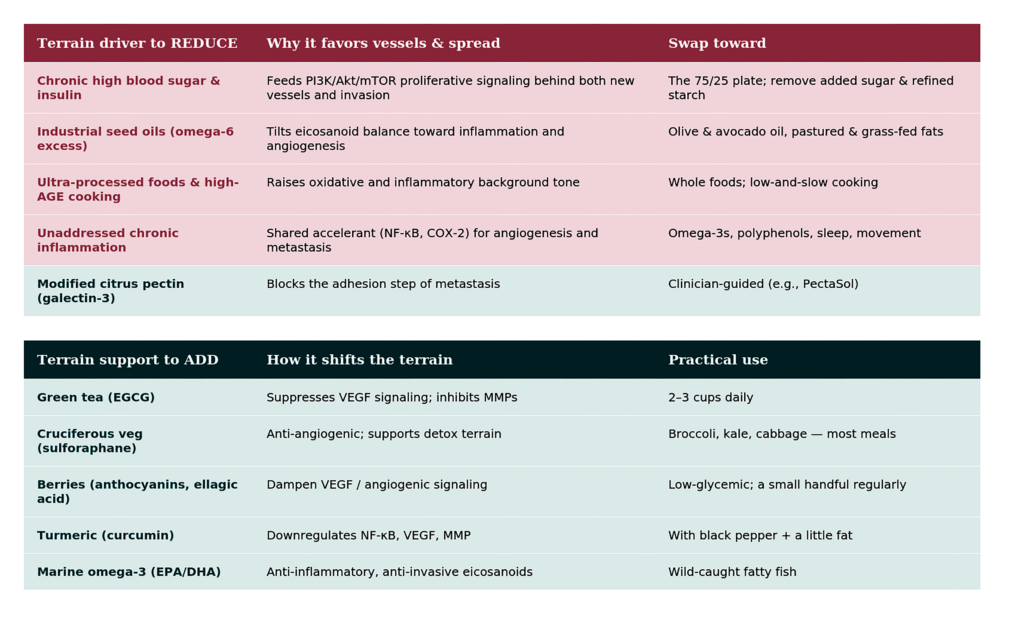
Read this as two lists: what tends to feed vessels and spread, and what tends to shift the terrain the other way. In the house color logic, rose marks a primary driver to reduce and teal marks a support to add.
Most of the food-specific data above is mechanistic (cell and animal studies) or epidemiological. That evidence is encouraging and biologically coherent — but it is not the same as randomized proof that any single food halts angiogenesis or metastasis in a person. Early-phase clinical trials of several of these strategies — ketogenic diets, green tea catechins, curcumin — are underway, though most are small and measure surrogate markers rather than survival. The honest framing is this: these choices move the terrain in a favorable, low-risk direction, while formal outcome trials remain limited. Nutrition here is complementary — it works alongside, and never instead of, the oncology team’s plan.
And here is what makes this an easy decision: unlike a drug, a whole-food, vegetable-forward, low-sugar way of eating carries no toxicity and no real downside. Set the cancer question aside entirely and it still improves blood sugar, cardiovascular health, energy, and resilience — for someone working to prevent disease and for someone in active treatment alike. That makes it a genuine no-regrets choice: at worst, you have simply eaten in a way that supports whole-body health; at best, you have also made the terrain less hospitable to the very processes described here.
One important caveat, though: well-nourished must mean nutrient-dense — not severely restricted, but equally not padded with empty calories. During active treatment, protecting weight and strength is a genuine priority, and unintended weight loss is a real risk. But the answer is calorie-dense whole food — quality fats like olive oil, avocado, and pastured animal fats, alongside ample protein — not ice cream, sugary shakes, or an “eat whatever adds pounds” approach. Loading sugar onto the plate to hold weight feeds the very glucose, insulin, and inflammatory drivers described in this article: it can move the scale while working directly against the terrain. Weight targets and any nutrition-support decisions belong with your care team.
|
References
Li WW, et al. Tumor angiogenesis as a target for dietary cancer prevention. J Oncol. 2012;2012:879623.
Nangia-Makker P, et al. Inhibition of human cancer cell growth and metastasis in nude mice by oral intake of modified citrus pectin. J Natl Cancer Inst. 2002;94(24):1854-1862.
Keizman D, et al. Modified citrus pectin treatment in non-metastatic
By Debbie Sweeney, BCHN, FDNp, ONC If you have ever been told to “boost your immune system,” you have probably…
Read MoreMeaningful conversations with survivors, caregivers, and experts. The CancerBuddy Conversation series brings together diverse voices in candid, uplifting dialogue—offering wisdom, shared experience, and real-life perspective from across the cancer community.
Learn More
With rising cancer rates, our work has never been more important. All donations for the Bone Marrow & Cancer Foundation go to services that directly help cancer patients, survivors, and families. The Foundation relies 100% on private donations. We depend on individual and corporate donors, as we don’t receive government or public funding. We offer innovative ways to contribute, and options for doubling the impact of donations. Thank you for your support, it means so much to so many patients.
Donate