Blogs
Hormones Are More Than Fertility
By Debbie Sweeney, BCHN, FDN-P, ONC
MamaSweeney Nutrition | Terrain Over Tumor
Say the word “hormones” and most people think reproduction. Periods, pregnancy, perimenopause, testosterone. In an oncology setting it narrows further still — to receptor status, to ER-positive or PR-positive.
That’s not wrong. It’s just far too small.
In The Metabolic Approach to Cancer, Nasha Winters and Jess Higgins Kelley name hormone balance as Terrain #8 of the Terrain Ten. But hormones aren’t really one terrain sitting beside nine others. They’re the signaling layer running through all of them.
Beyond estrogen, progesterone, and testosterone:
Any of these can be off while reproductive hormones look perfectly ordinary.
Blood sugar. Insulin is a hormone. Chronically high insulin lowers sex hormone binding globulin, which raises the free, active portion of estradiol and testosterone, and raises free IGF-1. A blood sugar problem becomes a sex hormone problem. This is why fasting insulin belongs on a hormone panel.
Inflammation. Fat tissue is an endocrine organ. Inflamed breast fat carries elevated COX-2 and prostaglandin E2, which raise aromatase — the enzyme that makes estrogen locally, in the tissue.[1][2] The same researchers later found this pattern in women with a completely normal BMI.[3] Which is the whole point: weight is an output of what’s happening in the terrain, not the lever. A normal number on the scale doesn’t mean a quiet hormone environment.
The microbiome. The liver packages estrogen for disposal and sends it out in bile. Certain gut bacteria unpackage it, and it gets reabsorbed. That bacterial collective is the estrobolome, and it meaningfully shapes how much estrogen stays in circulation.[4] Fiber, transit time, and microbial diversity are estrogen interventions.
Stress and circadian rhythm. Cortisol should have a shape — high in the morning, low at night. In 104 women with metastatic breast cancer, a flattened cortisol rhythm predicted earlier mortality and tracked with lower natural killer cell activity.[5] Melatonin runs the same axis: in 2019 the IARC classified night shift work as probably carcinogenic to humans, citing immune suppression, chronic inflammation, and cell proliferation as mechanisms.[6] Light at night is a hormone exposure.
Genetics and detoxification. How you metabolize estrogen matters as much as how much you make. It moves through phase I hydroxylation (CYP1A1, CYP1B1) and then phase II conjugation — methylation, glucuronidation, sulfation. Individual variation here is real, and it’s nutrient-dependent.
Toxic burden. Endocrine-disrupting chemicals are a hormone problem arriving through the toxin door. BPA, phthalates, parabens, certain pesticides, PFAS. They don’t have to be potent — they just have to show up daily. This is the reason behind glass storage, filtered water, and clean personal care. Those aren’t aesthetics.
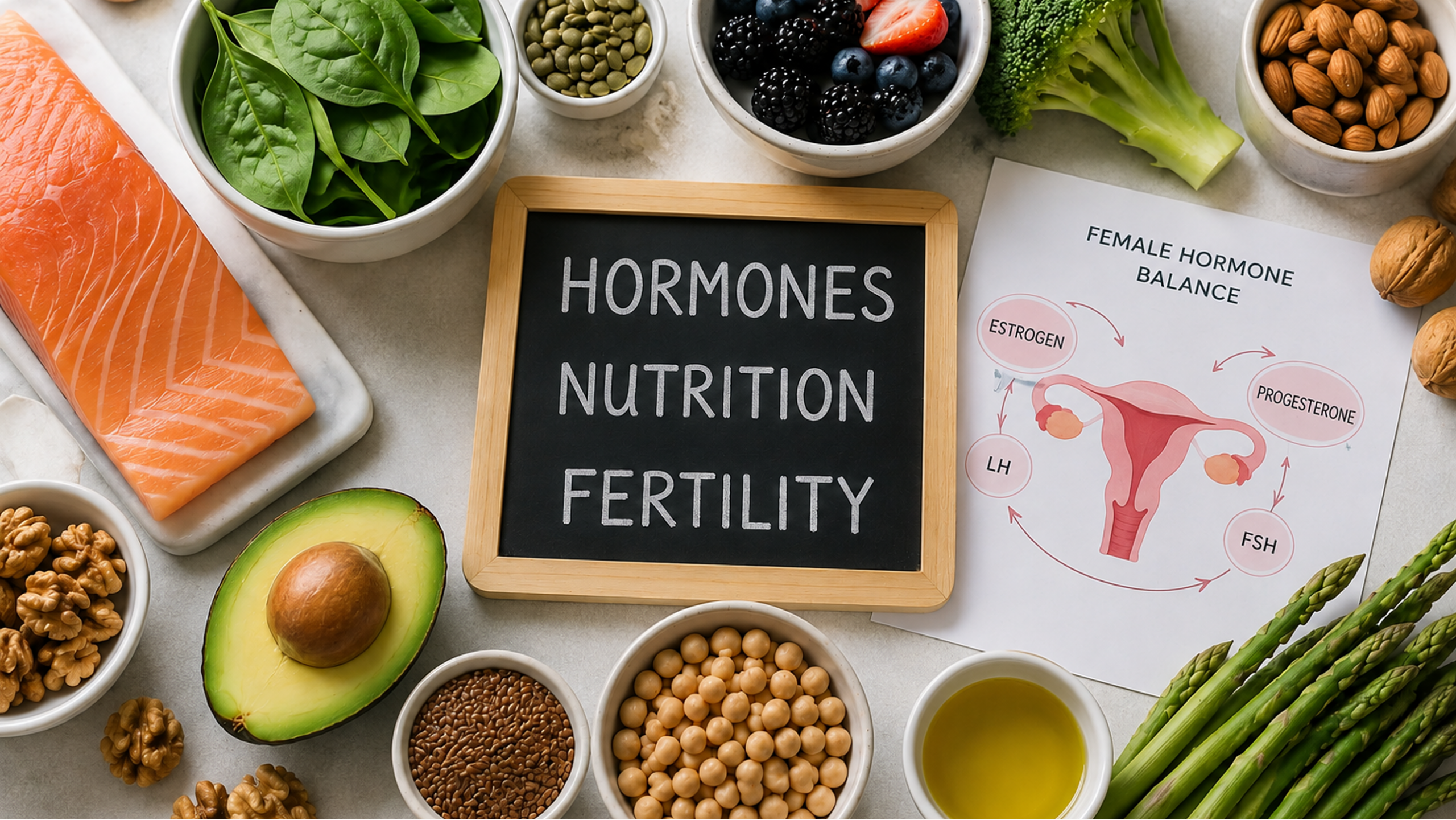
Food:
Daily rhythm:
Notice what’s not there: a calorie target or a scale goal. Given the normal-BMI aromatase findings, that would be chasing the wrong variable.
Fatigue, weight change, poor sleep, and low mood can all come from thyroid, cortisol, insulin, or sex hormones. Guessing usually means working hard on the wrong thing.
A useful starting picture generally includes a full thyroid panel rather than TSH alone, fasting insulin with glucose and HbA1c, SHBG, sex hormones in the right menstrual or menopausal context, a diurnal cortisol assessment, and vitamin D.
Hormone metabolite testing adds something serum levels can’t: it shows which pathways estrogen is traveling down, not just how much is present. That’s real, measurable biochemistry — and it’s a guide. It narrows where to look next, which nutrient cofactors to investigate, and what to recheck later. Read alongside your history and the rest of your labs, it turns guesswork into direction.
You can’t work the hormone terrain by looking only at hormones. Every real lever in Terrain #8 is also a lever somewhere else — which means the work you do for your blood sugar is hormone work. So is the work you do for your gut. So is going to bed in a dark room.
Terrain over tumor.
Debbie Sweeney, BCHN, FDN-P, ONC — MamaSweeney Nutrition
Debbie Sweeney, BCHN, FDN-P, ONC MamaSweeney Nutrition — integrative oncology and functional nutrition. Terrain Over Tumor. What cancer care could…
Read MoreInspired by Chapter 8 of The Metabolic Approach to Cancer (Winters & Kelley) By Debbie Sweeney, BCHN, FDNp, ONC …
Read MoreBy Debbie Sweeney, BCHN, FDNp, ONC If you have ever been told to “boost your immune system,” you have probably…
Read MoreMeaningful conversations with survivors, caregivers, and experts. The CancerBuddy Conversation series brings together diverse voices in candid, uplifting dialogue—offering wisdom, shared experience, and real-life perspective from across the cancer community.
Learn More
With rising cancer rates, our work has never been more important. All donations for the Bone Marrow & Cancer Foundation go to services that directly help cancer patients, survivors, and families. The Foundation relies 100% on private donations. We depend on individual and corporate donors, as we don’t receive government or public funding. We offer innovative ways to contribute, and options for doubling the impact of donations. Thank you for your support, it means so much to so many patients.
Donate